.png)


Clinical Skills in Glaucoma: A Course by Dr. Lorenz Kuske

Updated: Apr 6
We are pleased to share with you a newly published course in the field of practical glaucoma by Dr. Kuske - diagnostics, therapy, and surgical treatment, that is online and on-demand. Dr. Kuske aimed to compress years of glaucoma experience (including the one he acquired during his GAASS Fellowship with Dr. Ike Ahmed) into a clear, usable system.
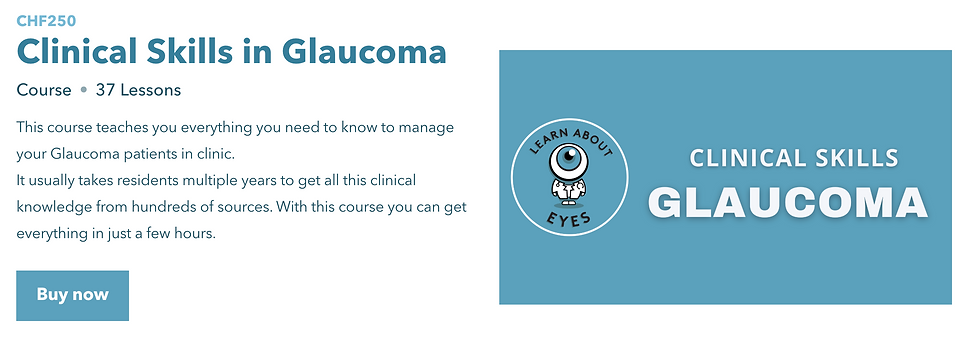
Course Length: 37 Lessons, divided into small digestible video clips Price: CHF 250 / EUR 270 / USD 320
The first 24 of you to use the code OPHTHALMOLOGY24 to get 24% off.
Who This Course Is For
Ophthalmology residents at any stage
Ophthalmology Fellows seeking structured glaucoma frameworks
Yong ophthalmologists aiming for faster, safer clinics
Why Most Residents Struggle with Glaucoma
Glaucoma is not difficult because of missing knowledge, it is difficult because of missing structure.
Residents are expected to integrate optic nerve assessment, OCT, visual fields, gonioscopy, IOP, and disease staging into coherent decisions, often under time pressure, often without a clear framework. The result is hesitation, over-reliance on single parameters, and slow, inconsistent clinics.
The Clinical Skills in Glaucoma Course aims to solve exactly this problem. The idea is not to make you “know more” but to make you think clearly and act decisively when managing glaucoma patients: in clinic, in exams, and in discussions with senior consultants.
Course Content Overview
Glaucoma Documentation: The Ike Ahmed Approach
This is the cornerstone of the course. You learn a documentation system that allows you to summarize any glaucoma patient in a single, structured sentence.
Is It Glaucoma?
A focused, visual chapter covering:
Cup-to-disc ratio and rim assessment
ISNT rule (and its limitations)
Alpha/beta zones
Disc size interpretation
RNFL evaluation
All concepts are clearly illustrated, with selected topics accompanied by downloadable reference guides for daily clinical use.

Type of Glaucoma
This chapter builds true understanding by:
Differentiating open-angle vs angle-closure disease
Explaining all mechanisms of angle closure
Teaching practical gonioscopy tips
Illustrate important grading systems
Introducing the role of AS-OCT and anterior segment examination

Glaucoma Staging
Most treatment decisions in glaucoma depend on staging, yet this is often inconsistently applied.
How to stage glaucoma correctly
How staging determines follow-up and therapy intensity.
Includes a downloadable staging reference table for daily use.

Glaucoma Progression
This chapter delivers the core philosophy of the course. You learn how to identify progression using:
Fundus examination
OCT (structural change)
Visual fields (functional change)
The emphasis is on clinical judgment, not software output, helping you decide when to
intervene and when to observe with confidence.


Glaucoma and IOP
IOP is discussed as a variable, not a fixed truth:
Different measurement techniques
Their limitations and sources of error
Clinical interpretation in real-world settings
This chapter prevents over-interpretation and false reassurance.

Glaucoma Treatment
Rather than overwhelming learners with procedural detail, this chapter provides a clear, big-picture overview of:
Medical therapy
Laser treatment
Surgical options, including MIGS
This is particularly valuable for residents navigating the rapidly expanding surgical glaucoma field.

Why You Should Consider Enrolling
For the cost, the Clinical Skills in Glaucoma Course offers:
summarised clinical decision-making
addresses the most common mistakes
systematizes patient presentations and gives you a structured system you can use
The first 24 of you to use the code OPHTHALMOLOGY24 get 24% off.

Dr. Lorenz Kuske, FEBO is a Swiss ophthalmologist who, after completing his ophthalmology training, pursued advanced subspecialty training abroad by undertaking a Glaucoma & Advanced Anterior Segment Surgery (GAASS) fellowship under the mentorship of world-renowned surgeon Dr. Ike Ahmed and his team at the University of Toronto. During this fellowship, he gained extensive experience in complex glaucoma and anterior segment surgery, which significantly deepened his surgical expertise and shaped his clinical approach. Upon completing his GAASS fellowship, Dr. Kuske returned to Europe, where he now practices in Switzerland, combining high-level surgical care with a passion for teaching and innovation in ophthalmology. Dr. Kuske is the founder of the Learn About Eyes Platform, where he shares his personal experience in a series of interesting, practical videos.

