.png)


How to Become a Better Cataract Surgeon?

Becoming a great cataract surgeon doesn’t happen overnight. It takes time, patience and practice, practice, practice. And even then, there's always room to improve. Mastering cataract surgery is a journey. It takes many years from starting your first cases in residency or as a young specialist to performing routine surgeries or complex cases.
We know how difficult the road to cataract surgery is. We know how many of you don't have many opportunities to perform cataract surgery in a clinical setting. So we made this guide.
Learn practical steps, personal development strategies, and get a few creative ideas to help you grow into a more confident, capable, and skilled cataract surgeon. Maximise your outcomes and use the few cases you get to get past the learning curve.
Cataract Observerships
Start by observing the surgery. Aim to be as much in the operating room as possible, where the magic happens. Even short-term observerships can give you powerful and lasting insights. Although you may not be the one holding the instruments, simply standing in the operating room of an experienced surgeon can be a transformative learning experience.
Observing surgeons tackling real cases allows you to understand and think about subtle techniques that are often difficult to capture in textbooks or lectures. Like the position of the wrist during phacoemulsification, the balance of fluidics, the choice of which second instrument to use in various situations. These small but critical details often separate good surgeons from great ones.
Try not to be a passive observer and try to put yourself in the surgeon's shoes. Imagine what would you do next, try to notice when things are about to go wrong EARLY. Think about how you can prevent certain things to happen. This is called active observership.
Watching how a surgeon adapts to unexpected challenges (a zonular dialysis, a posterior capsular rupture, a small pupil, Pseudoexfoliating Syndrome, etc.), makes you remember far more about managing complications than simply reading the chapter in a manual.
Observerships are a chance to study the "surgical ecosystem":
The way the surgeon communicates with the nursing team and anesthetists
Role of ergonomics and comfort for smoother surgeries
Importance of a calm environment for both the surgeon and the patient
The role of the surgeon as team leader to set the tone in the OR.
When selecting observership opportunities, seek out high-volume cataract centers or surgeons known for innovation and teaching.
Many experienced surgeons are happy to host motivated learners. A single well-chosen observership, even lasting just a few days, can offer insights that permanently shape the way you approach cataract surgery.
How to secure an observership? Simply write them an email saying that you are very interested in their center and ask if you can observe.
Breaking the Phaco Training into Steps
Like learning to drive a car, you cannot just jump and start racing. You need to take a stepwise approach when learning Phaco. We have the concept that you have to go through 3 fundamental steps before you are self-sufficiant cataract surgeon and can tackle basic cases on your own:
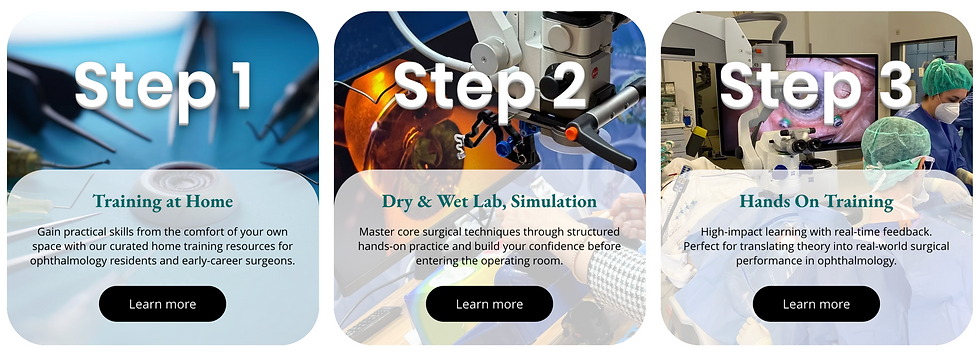
Practicing Your Microsurgical Skills Under Magnification
Being ready to start with cataract surgery steps requires a certain set of precision that you can train.
The best thing is that you need just a few instruments and magnifications to start practicing. Here are some great ideas on how you can improve your microsurgical skills at home or in your own clinic's OR.
Microsurgical Training
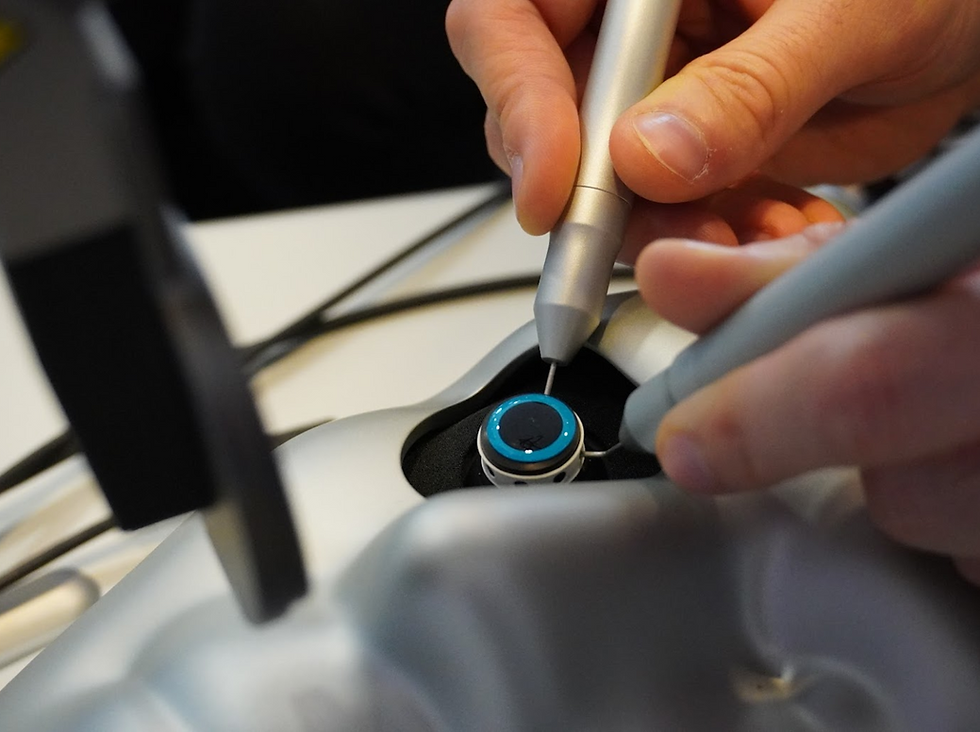
Practicing capsulorhexis on a plastic foil, peeling tomato skin or grapes or suturing on model eyes your ability to work delicately in soft tissues and with small instruments. Focus on movement first, improve difficulty and realism second.
Such odd exercises improve your tissue handling, depth perception, and instrument coordination. All of which are applicable in anterior segment surgery. Fun fact, some cataract training programs incorporate these cross-disciplinary techniques into early surgical education, and with good reason.
See more similar ophthalmology training at home videos on Instagram: @ophthalmology24 & @atanasbogoev
Manual Dexterity Exercises

Activities that require precision, control, and fine motor coordination can train your hands. Try:
Origami for folding symmetry and spatial awareness
Drawing or sketching with your inferior hand to improve visual-spatial perception and line control
Calligraphy to cultivate smooth, deliberate wrist movements
Playing a musical instrument (stringed or keyboard-based) to build rhythmic, coordinated hand activity
While these may not replace wet lab practice, they are an enjoyable and stress-free way to sharpen your surgical skills - and they keep your hands engaged even when you're away from the clinic.
Dry Lab, Wet-Lab and Simulation Lab Cataract Surgery Courses
Before you can master complex cases, you need to train your hands to do the basics right. A strong foundation starts with practical training. And while everyone wants to start in the operating room, it’s often safer and better to practice as much as possible in the lab first. If you spend time practicing, your learning curve will be steeper, and you will have much fewer complications in the beginning.

Check out our listed resource featuring a guide listing many of the top worldwide courses in ophthalmology.
Focused, hands-on cataract training in wet labs, simulator sessions, or structured courses allows you to learn techniques even before stepping into real surgical scenarios.
Hands-on courses promise a safe, controlled environment to develop core cataract surgeon skills:
Capsulorhexis
Hydrodissection techniques
Nucleus division strategies (e.g., divide and conquer, phaco chop)
Irrigation/aspiration finesse
IOL loading, insertion and wound closure

Look for wet labs with access to artificial or pig eyes, simulators, and experienced faculty providing one-on-one feedback. Many regional and international congresses (e.g., ESCRS, ASCRS) offer such courses. Make them a priority in your early career.
If you are serious and proactive enough to start NOW and not wait for the once-a-year conferences to get your wet/dry lab training, sign up for the cataract training course by Oftalmo University Europe in Barcelona.
RELATED: Cataract Training Courses Worldwide
Virtual Reality and Cataract Simulators
Modern simulators offer high-fidelity environments that closely replicate real-life surgical scenarios. Such tools often have performance scoring and give immediate feedback on parameters like phaco tip control, tunnel construction, and capsulorhexis centration.
Simulators are not just for beginners. Even experienced cataract surgeons can use them to practice rare situations like anterior vitrectomy or loose zonules.
If your institution has access to a simulator, use it as much as possible, set goals and track your improvement over time. If not, consider traveling to a center that does or enrolling in a course that incorporates simulator time. To finish the simulator course, you need at least a week.

Hands-On Cataract Surgery Courses
Hands-on training in ophthalmology emphasizes high-impact learning with real-time feedback on real patients, translating theoretical knowledge into real-world surgical performance.
Performing surgeries as a leading surgeon under the expert supervision is the best form of learnig and has the highest impact on your learning curve.
The most optimal place to receive this would be in your clinic with someone you know and trust as a mentor, who is interested in pushing you forward and helping you grow. This is, unfortunately, in our presente reality more difficult than it sounds.
Some centers in Egypt and India offer paid suppervised hands on training in cataract surgery. Have in mind that visiting such a center and performing 25 cases does not automatically make you a surgeon.
You need to think long-term - Where are you going to develop your career? Who can potentially be the experienced mentor that you turn to in case of complications? How to develop a system to keep improving your level after you come back from this hands-on training.
Cataract Training Fellowships
Completing a fellowship in cataract surgery can facilitate your surgical proficiency in Phaco. While residency provides foundational exposure, a focused fellowship offers the repetition, mentorship, and case diversity to truly refine your skills.
During a fellowship, you benefit from structured mentorship and progressive responsibility. You start with simpler cases and gradually manage more complex surgeries as your confidence and skill set grow. This environment allows you to develop technical finesse and sound surgical judgment under the close supervision of experienced faculty.
Another major advantage is exposure to a wide variety of cases, such as dense, white, or brunescent cataracts; loose zonules or traumatic cataracts; and cataracts with comorbidities. Facing these scenarios early in your career teaches you to anticipate challenges, adapt during surgery, and manage complications calmly and effectively.

Moreover, fellowships can refine your preoperative planning and complication management skills. Those are essential for patient safety and surgical outcomes. You'll learn how to identify risk factors preoperatively, plan alternative strategies, and manage intraoperative surprises with poise.
Many fellowships expose you to alternative cataract techniques, broadening your surgical toolbox for different practice environments or patient needs.
When choosing a fellowship, try to prioritize programs that align with your learning goals. Consider:
Caseload volume and case complexity
Access to hands-on training versus observer-only roles
The culture of teaching and mentorship
A good fellowship should push you outside your comfort zone while providing support. Think of it as an investment for your time and effort to become the surgeon you want with accelarated pace.
Video Review and Self-Audit
Recording your surgeries is maybe one of the most powerful learning tools for aspiring cataract surgeons. Watching yourself operate, ideally with a mentor or colleague, allows you to:
Identifying when complications happen and why they happen
Spot inefficiencies or unnecessary movements
Evaluate your instrument handling, phaco energy use, and foot pedal technique
Identify recurring patterns in complications or near-misses
Develop strategies to improve flow, posture, and decision-making
Just like athletes review game footage, surgeons should regularly revisit their own work. The habit fosters both accountability and growth.
Stay Curious, Humble, and Persistent
Becoming an excellent cataract surgeon is not about ticking boxes. It's about cultivating:
Curiosity - ask why things go wrong and how they can be done better
Humility - seek feedback regularly and reflect on complications
Persistence - improvement is rarely linear; plateaus are normal
Be open and speak with your scrub nurses, learn from anesthesia colleagues, and absorb wisdom from patients. Each interaction can make you a better surgeon.
Conclusion
There is no single path to excellence when striving to be a better cataract surgeon. But there are common traits among those who achieve it: discipline, adaptability, and a lifelong learning mindset. Seek hands-on experiences, learn from those ahead of you, and explore creative ways to sharpen your skill set. Your future patients will thank you, and so will your future self.
ABOUT THE AUTHOR
Atanas Bogoev, M.D., FEBO is a consultant ophthalmologist, eye surgeon, and co-founder of Ophthalmology24. Atanas has trained internationally, attending courses at Harvard Medical School, Oftalmo University, and completing observerships such as the GAASS program in Toronto. He combines surgical experience with a passion for education, translating surgical best practices and clinical learning into accessible resources.
Disclosure: This webpage contains referral links. The recommendations are genuine and are NOT sponsored. Explore other options yourself, and if you find something better, let us know so we can include it.